Ryumonji is a Soto Zen Buddhist Monastery formally registered as a temple with the Soto Zen Headquarters (Sōtōshū) in Japan, placing it within an unbroken institutional lineage that stretches back centuries — a recognition that connects this quiet Iowa monastery to the living heart of the Zen tradition.
The name "Ryu-mon-ji" is composed of three Japanese characters meaning "Dragon Gate Temple." It is an ancient name rooted in Chinese legend, and its meaning runs far deeper than a simple translation suggests.
The legend tells of a great gate that stands in the ocean, where enormous waves rise ceaselessly, one after another. Countless fish attempt to pass through, but only those with the strength, determination, and courage to push through the crashing surf are transformed — they become dragons. In East Asian mythology, dragons are not fearsome creatures but noble ones, embodying great strength, wisdom, and compassion. They are symbols of awakened power in service of all beings.
The teaching embedded in this legend is both humbling and encouraging. The waves at the Dragon Gate are not extraordinary — they are the same waves found everywhere. The turbulence of everyday life, the difficulties of relationships, the pressures of work, illness, loss, uncertainty — these ordinary waves are the Dragon Gate. We are already standing before it. How we meet and move through these waves, with presence and integrity, is the fundamental human challenge. Zen practice is, in this sense, the training of the dragon.
Ryumonji is firmly rooted in the Zen Buddhist tradition, which itself grows from the oldest soil of Buddhist practice. When Shakyamuni Buddha attained enlightenment beneath the Bodhi tree around 500 B.C., the practice at the core of his awakening was seated meditation — a disciplined, direct investigation of mind and reality. In the ancient Indian tradition, this practice was known as Dhyana, a Sanskrit word pointing to deep meditative absorption and clarity.
As Buddhism traveled north and east along the Silk Road into China, Dhyana became Chan — and a distinctly Chinese school of Buddhism took shape, one that emphasized direct experience over doctrinal study, and the intimate relationship between teacher and student as the living vehicle of transmission. When Chan crossed the sea to Japan, it became Zen, and it was there that the Soto school was established by the great master Eihei Dogen (1200–1253), who brought the teaching from China and gave it profound philosophical and poetic expression. Dogen's emphasis on shikantaza — "just sitting," whole-hearted, unconditional zazen — remains the cornerstone of Soto Zen practice to this day.
Soto Zen carries a deep and carefully preserved ancestral lineage, a continuous thread of transmission from teacher to student reaching back to the Buddha himself. Yet true Buddhism, at its heart, transcends sectarian boundaries and denominational labels. The invitation to wake up, to see clearly, and to live with compassion belongs to no single tradition — it belongs to anyone willing to sit down and look. At Ryumonji, all are welcome, regardless of background, belief, or prior experience.
The founding teacher and Abbot of Ryumonji is Reverend Shoken Winecoff, whose own path reflects both deep personal commitment and a direct connection to some of the most important figures in the transmission of Zen to the West.
Rev. Winecoff is a disciple of the late Dainin Katagiri Roshi, one of the most beloved and influential Zen teachers of the twentieth century. A Japanese priest who came to the United States in the 1960s, Katagiri Roshi dedicated his life to planting Zen practice firmly in American soil. He served for years at the San Francisco Zen Center alongside Shunryu Suzuki Roshi, and later founded the Minnesota Zen Meditation Center in Minneapolis, Minnesota, where he taught until his death in 1990. Katagiri Roshi was known for his warmth, his precision, and his unwavering insistence on returning, always, to zazen.
Rev. Winecoff received dharma transmission from Katagiri Roshi in 1989. Following transmission, he undertook three years of rigorous monastic training in Japan at Zuioji Senmon Sodo, one of the principal training monasteries of the Soto school. This period of immersive practice in Japan deepened his understanding of traditional monastic form and gave Ryumonji its grounding in authentic Soto training standards. It is from this foundation — both the intimacy of the teacher-student relationship and the rigor of classical monastic discipline — that Ryumonji was born.
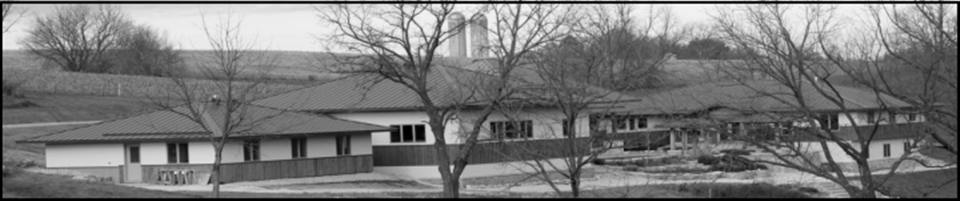
A forty acre farm was donated in February 2000 for the development of Ryumonji. During the first two years many volunteers worked to clean up the farm land and renovate the existing buildings. The farm house was originally a 1890’s log cabin, and the second floor was used as the original zen meditation room. The barn was renovated for workshop use and the grainery renovated for storage.
The Buddha Hall (Hondo), was the first of Ryumonji's permanent monastery buildings, dedicated on June 27, 2004. The 40' x 52' timber-framed structure constructed with traditional Japanese techniques, with its metal roof and in-floor heating, serves as the spiritual center of the monastery — the place where services, ceremonies, and dharma lectures are held.
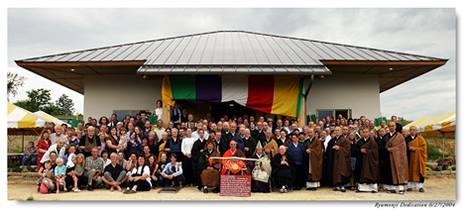
Buddha Hall Dedication
June 27, 2004
The Entry Gate (Sanmon) was completed in 2005 and stands as one of Ryumonji's most meaningful structures. More than an architectural feature, it is a threshold — a traditional passageway marking the transition from secular life into the space of the monastery. To pass through the Sanmon is to leave behind, at least symbolically, the preoccupations of the everyday world and to enter with intention. The gate does not merely mark a boundary, it invites a shift in mind and presence for all who arrive.
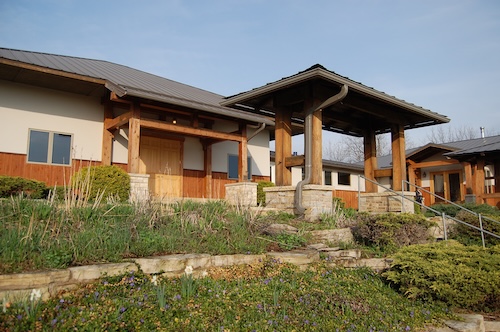
Entry Gate
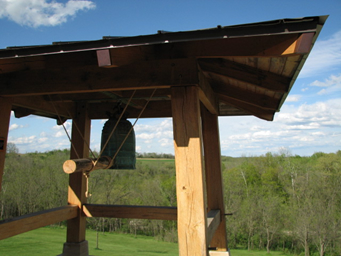
The Bell Tower (Shoro), is a traditional and essential structure of the Zen monastery. Completed in 2005, it stands as both a functional and deeply symbolic presence on the grounds. At Ryumonji, the bell's voice rolls across the open land and echoes throughout the surrounding valley, gathering the community to service and marking the rhythm of monastic life. In this way, the bell has the same function it has held in Zen monasteries for centuries: to remind all who hear it, near or far, to wake up.
The Kuin is Ryumonji's kitchen and residential facility, dedicated on June 26, 2007. The two-story, 46' x 70' building serves as the practical heart of the monastery, housing a large commercial kitchen, a communal dining hall, residential quarters for guest participants and resident teachers, an office, and a library/dokusan (interview) room. The building is also equipped with an efficient geothermal heating and cooling system, reflecting the community's commitment to responsible stewardship of the land.
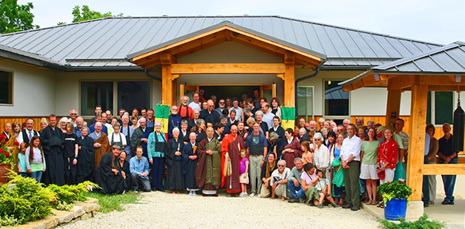
Kuin Dedication
June 2007
The Sodo, or Monks' Hall, was dedicated on June 26, 2011. Built to ancient traditional standards passed down through India, China, and Japan, it serves as the residential and practice space for monks in training, who eat, sleep, and sit zazen within its walls. The Sodo is also open to the general public for the practice of zazen meditation.

Sodo Dedication
June 2011
The final building completed for the monastery was the Shuryo, or Residential Study Quarters, completed in 2013. Attached directly to the Sodo, it functions as a complementary space designed to support those in residential training — providing private study quarters and bath facilities for monks and practitioners living in the Sodo during practice periods. Together, the Sodo and Shuryo form a complete residential and training environment, allowing practitioners to live, study, sit, and rest within the monastery grounds without interruption — the kind of immersive, self-contained setting that traditional monastic training has always required.

.png)